
Reliable positive anchor
Every training group receives one precise, task-valid positive rollout.
Efficient and scalable reinforcement learning for unified video MLLMs. OraRL turns every annotation into a reliable positive rollout while preserving on-policy exploration.
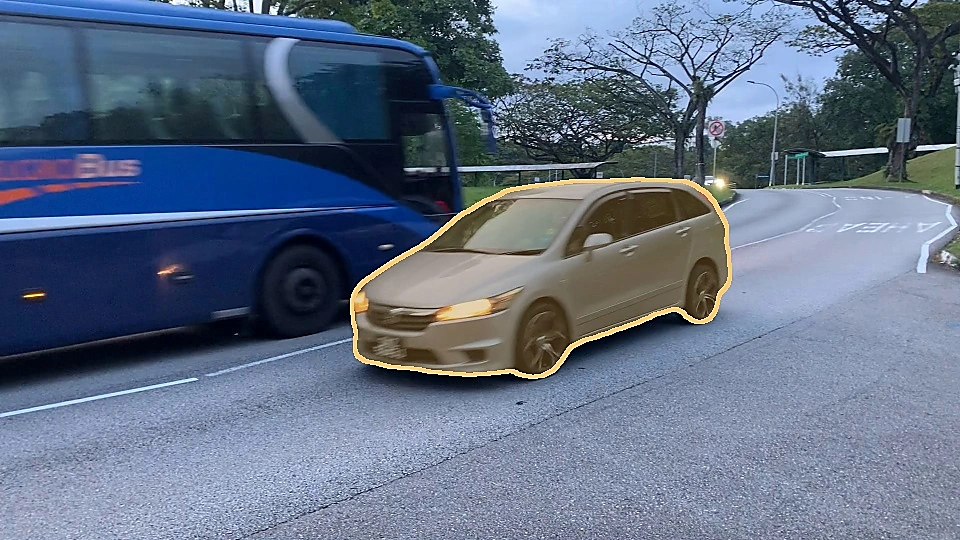 Segmentation
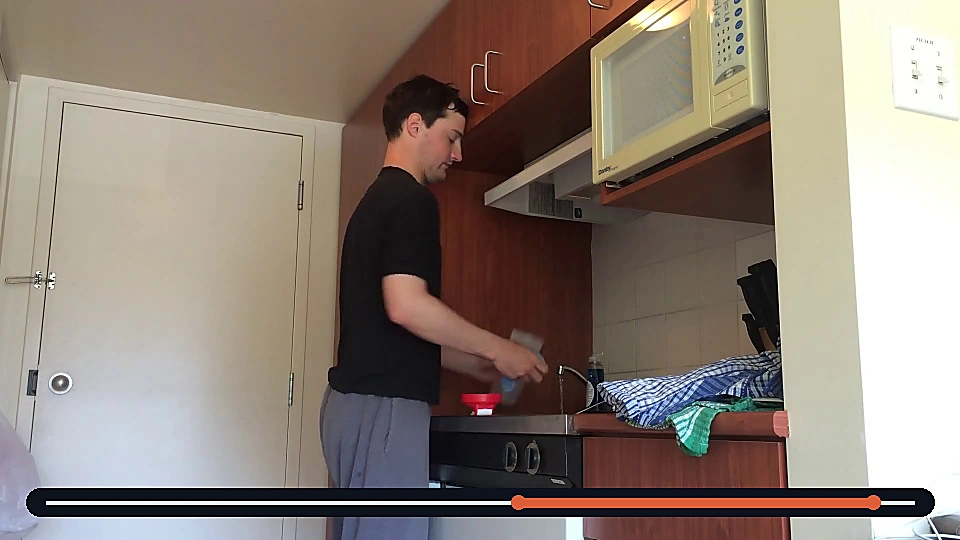 Temporal grounding
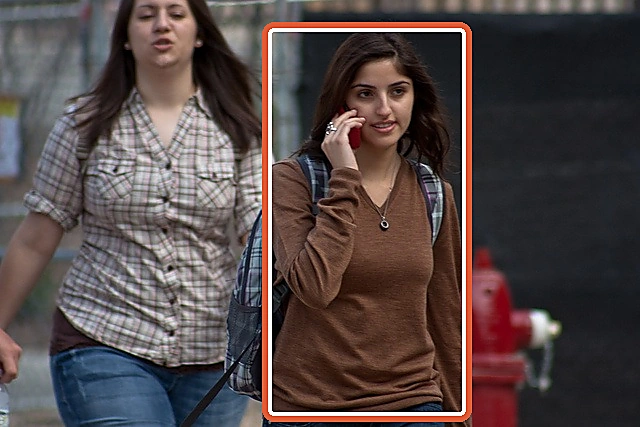 Spatial grounding
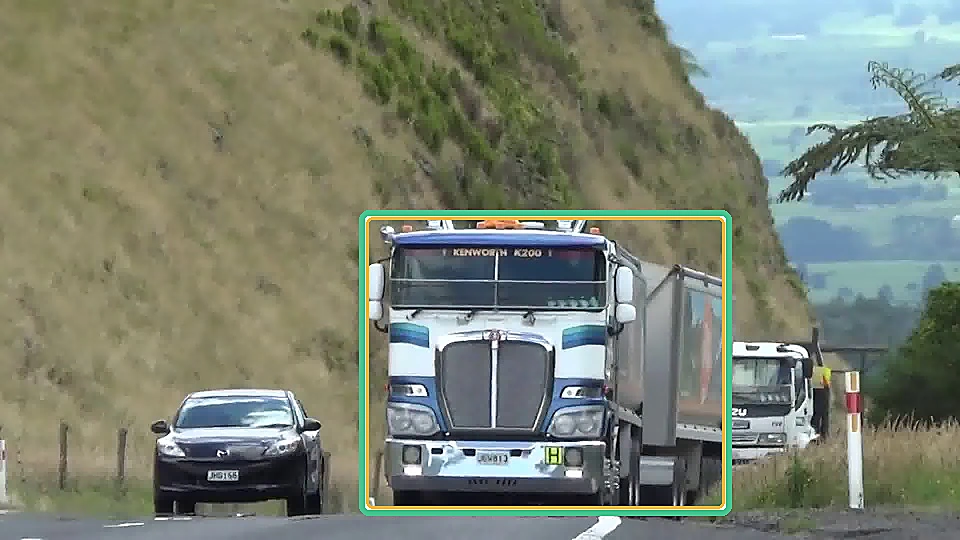 Visual tracking
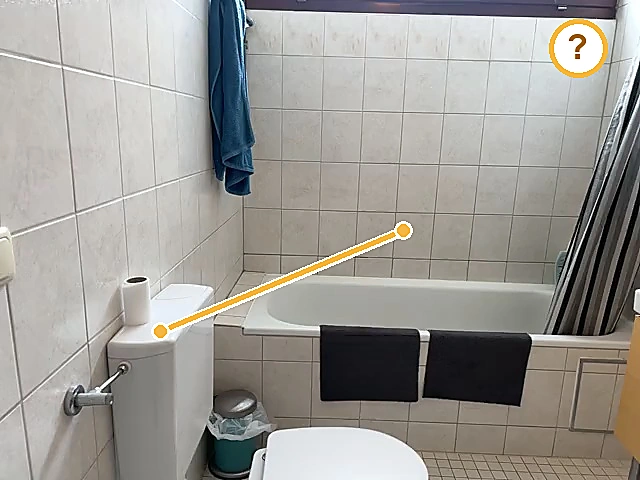 Spatial intelligence
A visual overview of the motivation, method, results, and efficiency.
Existing video RL uses annotations only to score sampled responses. OraRL also serializes each annotation as an oracle rollout—a direct, task-independent positive target.
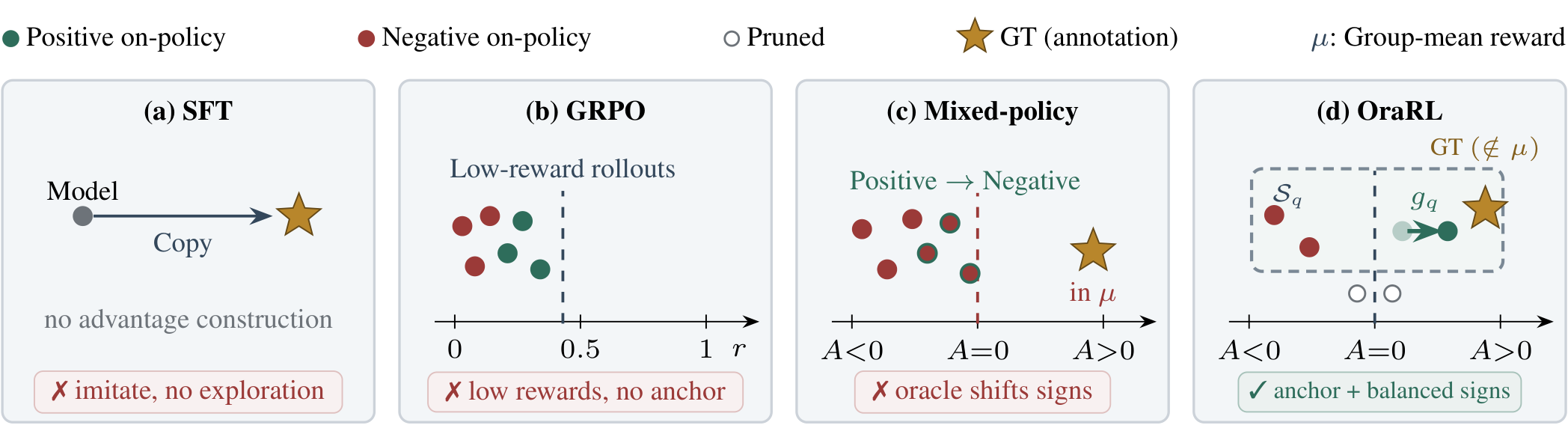
Every training group receives one precise, task-valid positive rollout.
On-policy rewards alone define the baseline, preventing advantage inversion.
The annotation supplements sampled behavior rather than replacing it.
The policy group sets a clean reference. The oracle–policy gap then strengthens promising rollouts and supplies a separate detached anchor.
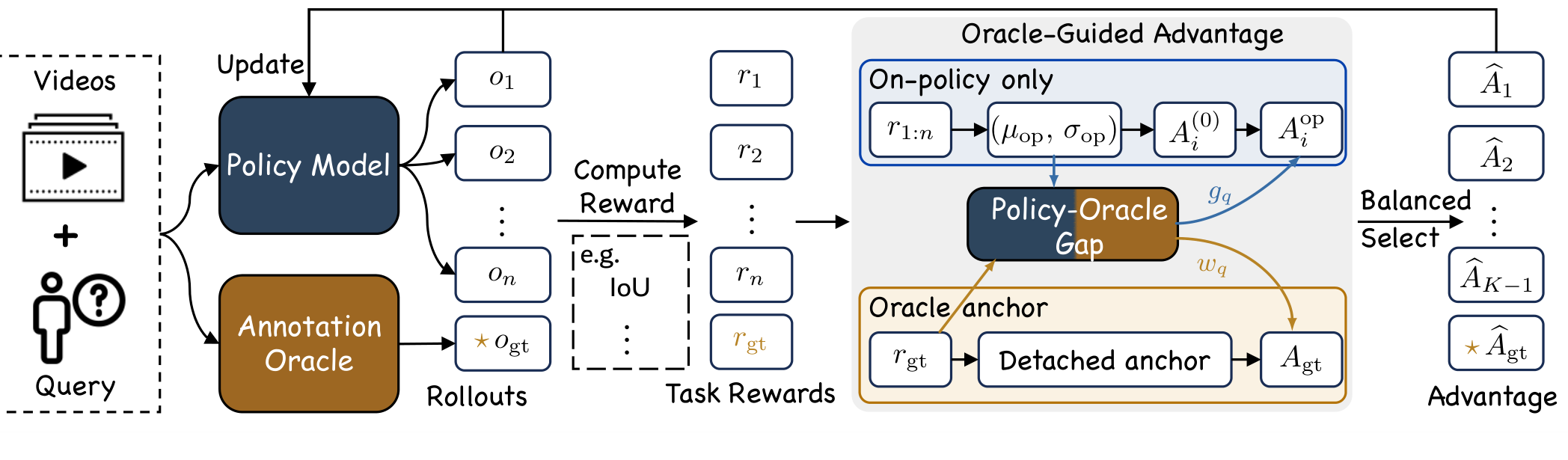
Serialize intervals, boxes, masks, trajectories, or answers into the model’s native response format.
Normalize only on-policy rewards so rollouts keep their correct policy-relative signs.
Use the oracle–policy gap for a bounded directional gain and a detached oracle advantage.
Retain strong positive and negative signals with the oracle, then restore update moments.
Video-ORA-9B improves over its backbone and every displayed baseline across unified video perception—without chain-of-thought decoding.
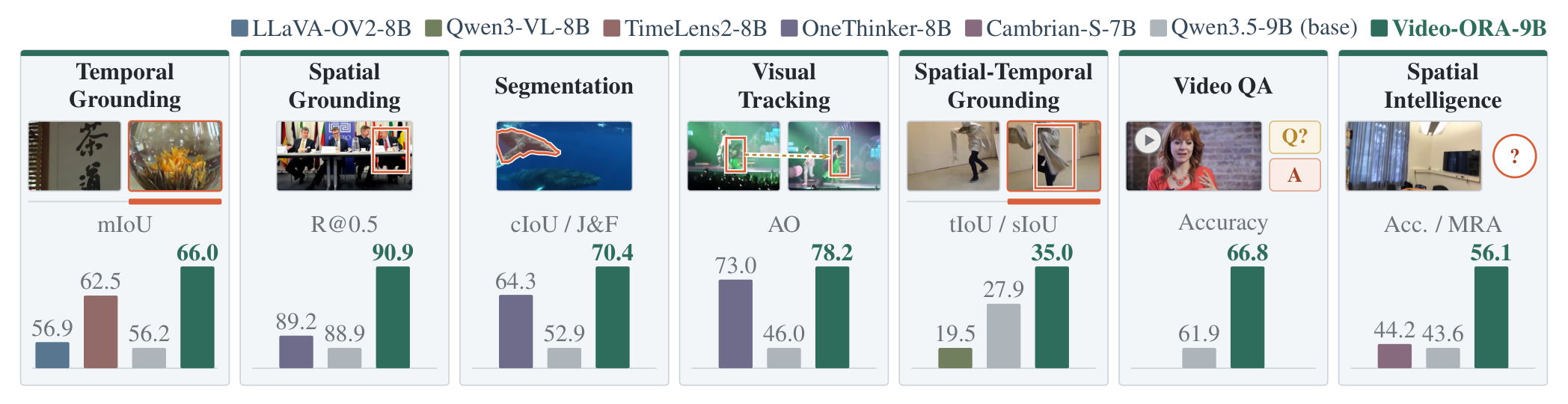
mIoU, up from the prior best of 62.5.
Average overlap on GOT-10k.
Aggregate cIoU / J&F family score.
Best reported overall average.
Selective back-propagation shortens updates, while answer-only generation removes costly reasoning traces at inference time.
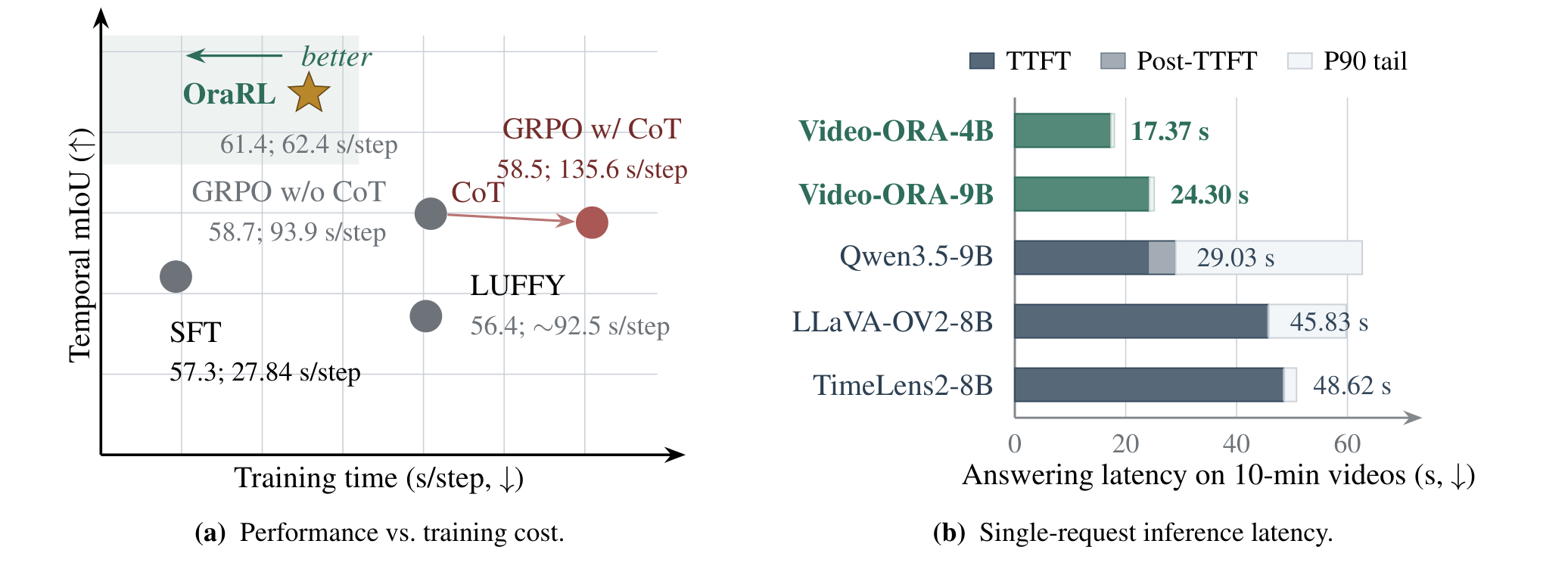
Higher temporal mIoU with substantially less update time than GRPO.
Answer-only decoding on ten-minute videos, without generated reasoning traces.
@article{li2026orarl,
  title   = {Annotations as Rollouts: Efficient and Scalable
             Reinforcement Learning for Video MLLMs},
  author  = {Li, Yunheng and Mu, Guohong and Li, Hao and
             Qian, Shengsheng and Zhang, Dingwen and Hou, Qibin
             and Cheng, Ming-Ming},
  journal = {arXiv preprint arXiv:2608.20492},
  year    = {2026},
  url     = {https://arxiv.org/abs/2608.20492}
}